An approach comparison, without the marketing

Lovable or ClickMVP?

Both use AI to build software. The difference is the starting point: one asks the model to write your application from scratch, the other starts from more than 1,600 real application models and adapts one to your business.

7 days with everything unlocked. No credit card.

From describing the idea to the running system, inside ClickMVP.

The same request, two different paths

What happens between your prompt and your code.

A builder that starts from the prompt

The model writes the application on every request.

Prompt
Language modelwrites from scratch
Codewhatever fits in the conversation

ClickMVP

The AI understands the business and the generator writes the code.

Prompt
The AI understands the businesssystems analyst questions
Searches 1,600+ modelsof real applications
Selects the best modelthe closest to your case
Adapts it to your business
Complete applicationbackend, frontend, access, tests
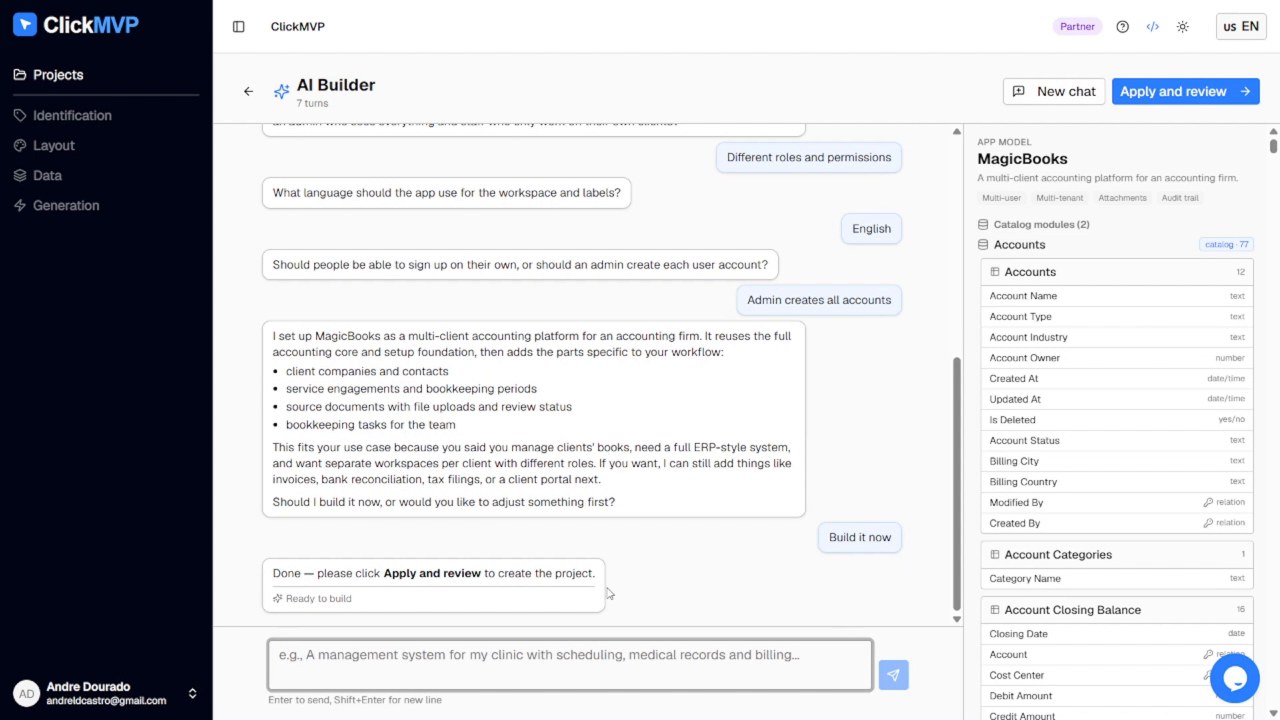
ClickMVP AI Builder conversation, with the application model being assembled alongside

The middle of the path the comparison above describes: the AI asks about roles, language and user registration, and the application model is assembled on the right, table by table.

Where the two part ways

  Lovable ClickMVP here
Starting point Starts every project from zero Reuses the knowledge of more than 1,600 real applications
How the idea is captured A prompt based conversation A conversation driven by requirements analysis, the way a systems analyst would
What gets generated Generation focused on screen code Generation of the complete application, from the data model to the screens
Backend Leans on managed services you integrate Its own backend in Node.js with Fastify or Java with Spring Boot, on PostgreSQL
Product foundations You add them as you need them Roles and permissions, multi-tenancy, billing and audit in the first generated project
Maturity of the result A prototype that communicates the idea fast An application ready to keep evolving, with architecture meant for production
After generation Evolution inside the tool Code entirely yours, with claude.md and agents.md to continue in Claude Code, Cursor or Copilot

An approach comparison, written from what each product documents publicly in August 2026. Lovable is a trademark of its respective holders, unrelated to ClickMVP. Tools change: if something here went out of date, write to support@clickmvp.com and we will fix it. For the long version, with what 994 Reddit posts say classified one by one, read Lovable vs ClickMVP.

The difference shows up at the first paying customer

Anyone can make a pretty prototype. What stalls a project is what comes next: who can see what, how two customers coexist in the same database, who touched that record, how billing fits in. At ClickMVP that is not a future task, it is part of what gets generated.

  • Login, protected sessions and password recovery ready
  • Roles and permissions per screen and per action, with management screens
  • Several customers with isolated data, no mixing between accounts
  • Audit trail with query and export
  • Integrated billing, with plans and cancellation
  • API documented in OpenAPI and three layers of tests
  • PostgreSQL database versioned by migrations
Node.js and Fastify Java and Spring Boot React Next.js Angular
the project you download
# a standard project, with no platform runtime
myapp/
├─ backend/ domain, application, infrastructure
│  ├─ modules/ one module per registry
│  ├─ auth/ login, roles, permissions
│  └─ tests/ unit and route
├─ frontend/ list, form and detail screens
│  └─ e2e/ end to end tests
├─ claude.md context for AI agents
├─ agents.md
└─ README.md
✓ opens in any IDE, runs on your infrastructure
549 files generated
201 in the backend, 348 in the frontend
115 REST endpoints, all described in OpenAPI
56 test files: unit, route and end to end
9 versioned migrations, from the first commit

On the ClickMVP side, measured on a real project of 14 registries generated in React with Spring Boot: 54,800 lines, none written by hand. A comparison carrying numbers from the other side depends on running the same system on both platforms, and ships when that measurement exists.

What people ask when switching

For anyone who wants to go from an idea to a real system, yes. The difference is the starting point: instead of asking the model to write the application from scratch on every prompt, ClickMVP searches more than 1,600 real application models, picks the closest to your case, adapts it to your business and generates the code from deterministic templates.
A complete backend that runs on its own: Node.js with Fastify and Prisma, or Java with Spring Boot, on PostgreSQL, with authentication, roles and permissions, per-customer data isolation, billing, audit and OpenAPI documentation. It is not a thin layer over a managed service.
Yes, that is the point. You download a standard project and open it in any IDE, with no runtime of ours. It also ships with claude.md, agents.md, Spec Kit and AWS Kiro, so Claude Code, Cursor and Copilot understand the architecture from the first prompt.
Seven days with everything unlocked and no credit card. After that the account turns read-only, nothing disappears, and you choose between the Project plan ($149 once, with lifetime access to that project) and Unlimited ($15 per month). Every line generated during the trial stays yours. See the plans

Try ClickMVP for free

More than 1,600 real application models as a starting point. 7 days with everything unlocked, no credit card.

Build my first application →