Describe your idea. ClickMVP talks to you like a systems analyst, automatically finds the closest match among more than 1,600 real applications and generates a complete system, ready for production.
Everything unlocked for the first 7 days. The generated code is yours, even after.
Analysis before code
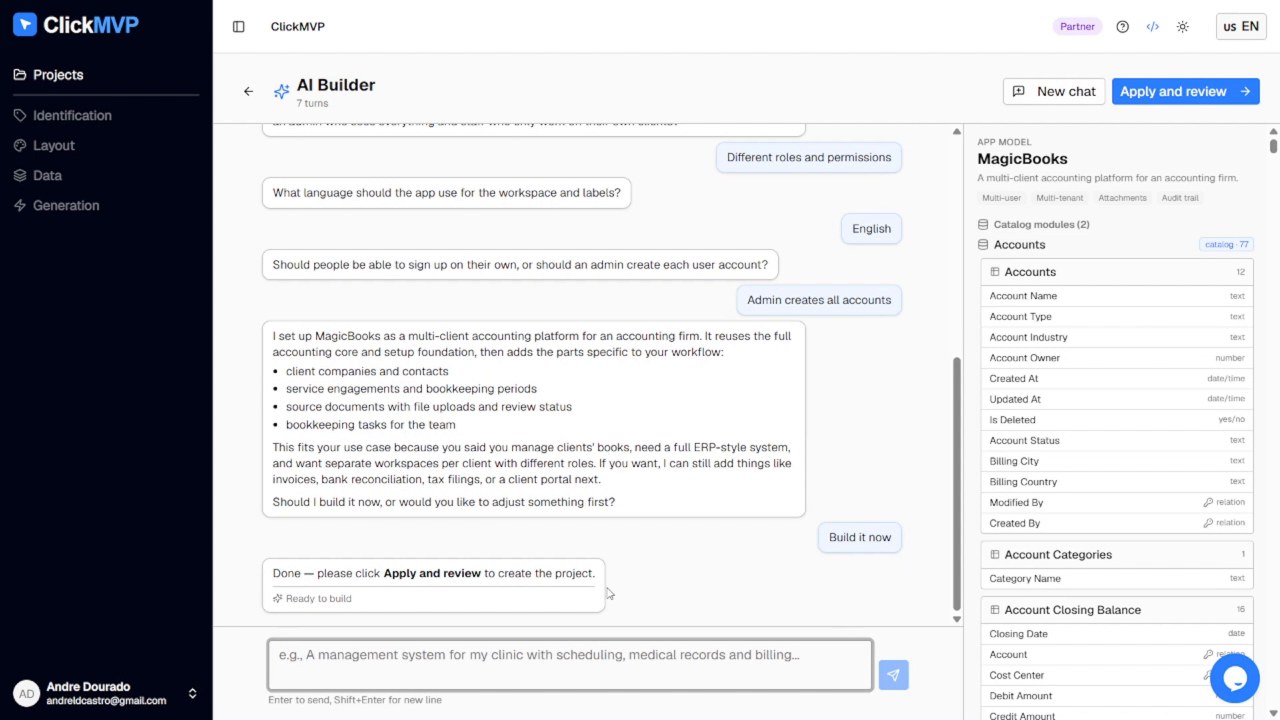
Before generating any code, ClickMVP understands your business. It asks questions to grasp rules, processes and requirements, the way an analyst would in a discovery meeting. Only then does it pick the best model among more than 1,600 and generate the application.
That is why the result does not look like a demo: the right questions up front change what comes out the other end.
The conversation inside the product: the AI asks about roles and permissions, language and how people sign in. On the right, the application model being assembled in real time, table by table.
How it works
You talk in plain English. The rest happens on its own.
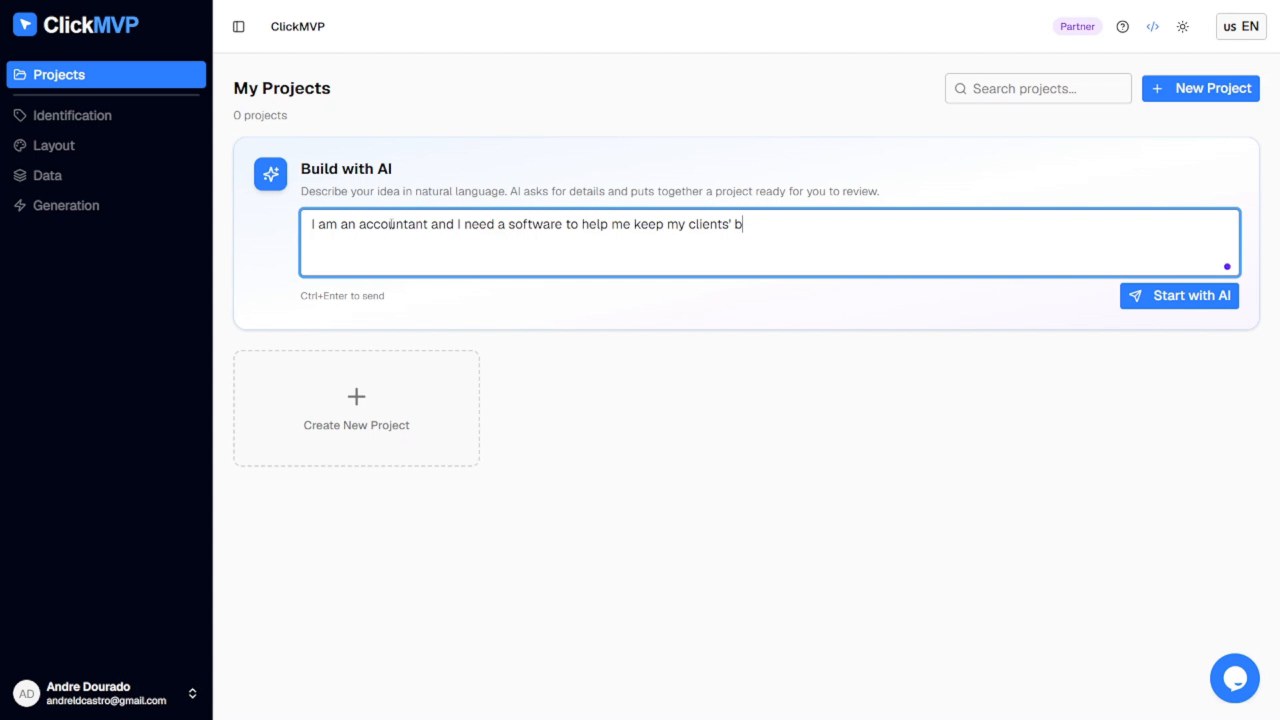
In one sentence or one paragraph. "A system for my clinic to track patients, appointments and payments" is already enough to start.
It digs into what the system has to track, who uses it, what each profile can do, and where billing, documents and reports come in.
Your idea is compared against more than 1,600 models of real business applications. The best fit is chosen and adapted to your business.
Backend, frontend, database, screens, permissions, documentation and tests come out ready, in whatever stack combination your project calls for.
Step 1 inside the product: one sentence describing the idea is enough to start.
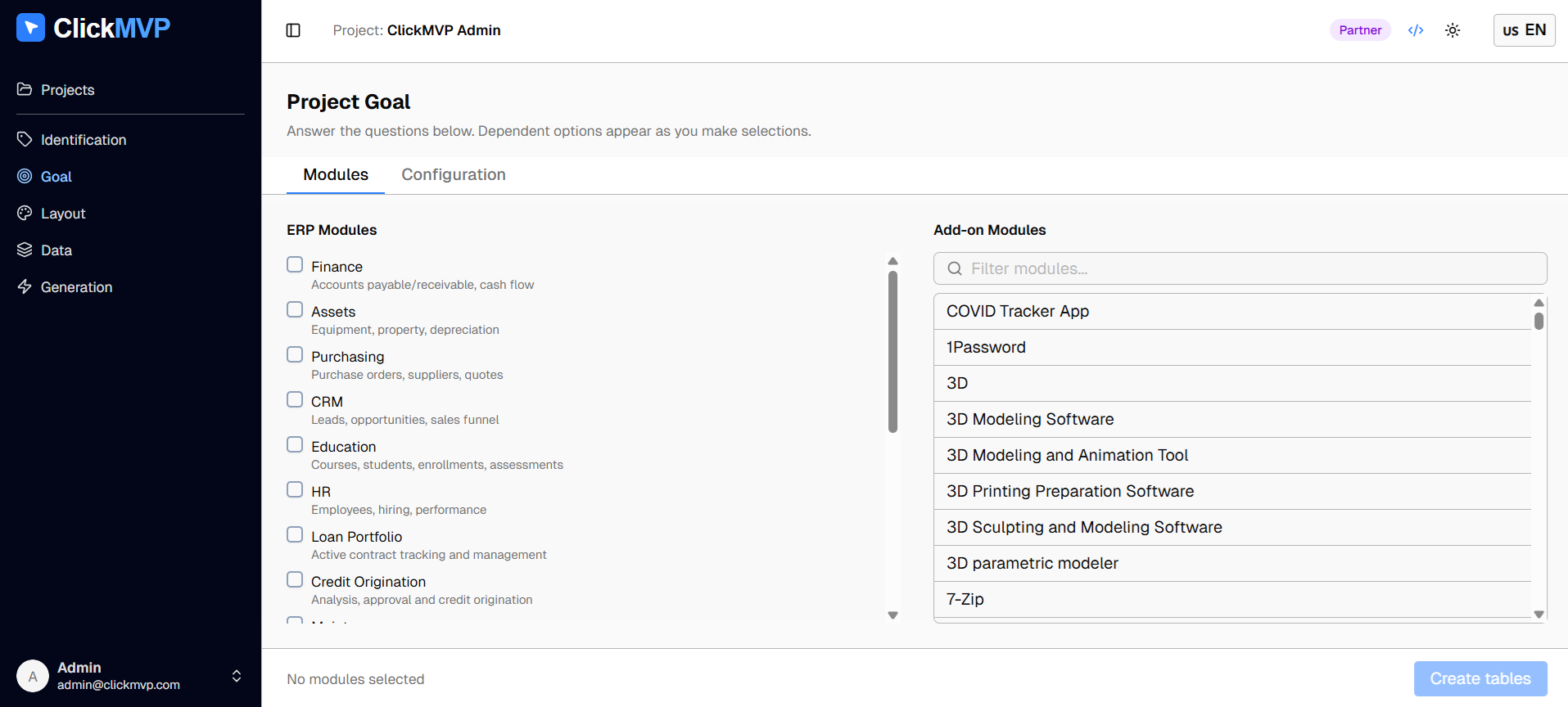
The library from the inside: ERP modules and hundreds of standalone models, where your project's foundation comes from.
What makes ClickMVP different
Instead of generating everything from scratch on every prompt, ClickMVP uses a library of more than 1,600 business application models, drawn from open source ERPs, industry reference databases and curated models.
Your idea is compared against those models. The best fit is selected, adapted to your business and turned into a production-ready application. That is why your patient registry is born with the fields and relationships a real system has, instead of four demo fields.
Comparison
The difference is not in using AI. It is in what the AI has in hand when it starts.
The model writes the application on every request.
The AI understands the business and the generator writes the code.
| Other AI builders | ClickMVP here | |
|---|---|---|
| Starting point | Start from zero on every project | Reuses more than 1,600 real application models |
| What gets generated | Generate code, screen by screen | Generates the complete application, from database to screen |
| Backend | Limited backend, often just enough for the demo | Complete backend: Node.js with Fastify or Java with Spring Boot |
| Maturity | A prototype to show the idea | Architecture meant for production, with access control, audit and billing |
| Code ownership | Dependent on the platform to run and evolve | 100% your code, a standard project that opens in any IDE |
| Continuity | You go back to the tool's chat for every change | Continue in Claude Code, Cursor or Copilot, with the context files already in the project |
See it working
From describing the idea to the running system, with no magic cuts.
What gets generated
Everything below ships in every project, in any stack combination you choose.
Frontend with list, form and detail screens for every registry, navigation, theming and translations in English, Portuguese and Spanish.
Complete backend in Java with Spring Boot or Node.js with Fastify and Prisma. The API contract is the same, so any frontend pairs with any backend.
Domain, application and infrastructure kept apart, a DTO distinct from the persistence entity, and constructor injection. True for every stack.
Secure login, protected sessions, password recovery and code verification. Tokens in HttpOnly cookies, never exposed to the browser.
Access control per screen and per action, with the management screens ready. Each person sees and does only what they may, with no patching.
Who created it, who changed it and when, recorded by default, with a query screen and export. The requirement that always shows up, and never at the start.
The database is born versioned: the schema history ships with it, so the project comes up on any machine with one command.
Every route described in the OpenAPI standard, with a browsable Swagger. Integrating with another system stops being archaeology.
Unit tests, route tests and end to end tests generated along with the code, ready to run in your CI.
You also get multi-tenancy (several customers with isolated data), integrated billing, file upload, a Docker Compose development environment on the Node.js stack, and the files that make the project AI-ready: claude.md, agents.md, Spec Kit and AWS Kiro. See the architecture from the inside
ClickMVP adapts the generation to the stack chosen for the project
Any frontend pairs with any backend, because the API contract is a single one authored by the generator: switching sides does not rewrite the other. .NET with C# and Vue.js are on the public roadmap.
Technical proof
Numbers from a real project generated with ClickMVP: a field service system with 14 registries. This is what comes out before you write the first line, in any stack combination.
A larger project generates more, a smaller one generates less: the volume follows your data model. What does not change is what ships with it, at any size: access control, audit, multi-tenancy, billing, documentation and tests.
Frequently asked questions
More than 1,600 real application models at your disposal. 7 days with everything unlocked, no credit card.
Build my first application →